
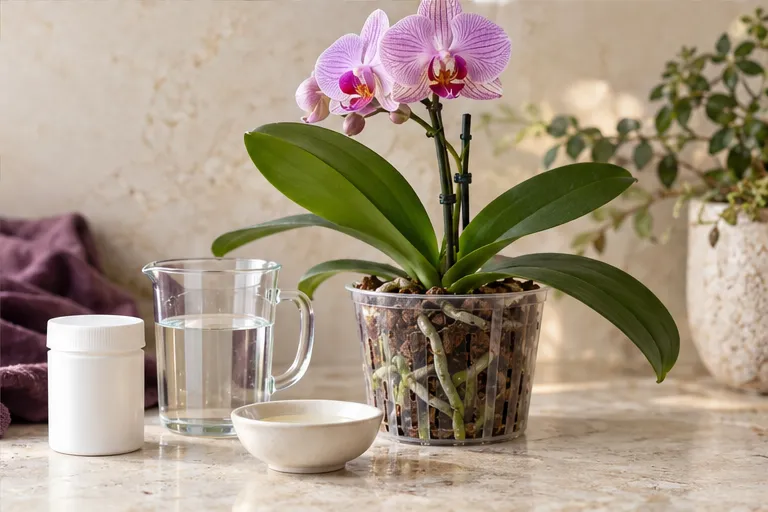
Read your product label
The three main numbers on a fertilizer label describe nitrogen, phosphate and potash. Products also differ in micronutrients, concentration and the way their directions are written. A recipe for one brand is not a recipe for another.
Look for a product intended for orchids or one whose instructions clearly cover the plants and growing system you use. A complete feed should supply more than the three headline nutrients. Follow the label's orchid directions when they are provided.
Do not divide an already weak orchid-specific rate again merely because someone said “quarter strength.” First identify the reference rate. A general houseplant rate and an orchid maintenance rate may already be very different.
Measure the dilution
To keep the same concentration, scale the fertilizer and water together. For example, a label rate of 4 mL per 1 liter becomes 2 mL for 0.5 liter. If the label allows half strength, that smaller batch takes 1 mL. These numbers illustrate the calculation; enter the rate on your own product.
Use a dedicated measuring tool and keep it out of food use. Dissolve water-soluble fertilizer fully, label stored solution if the manufacturer allows storage, and keep products away from children and pets. Never mix concentrated products together unless their labels explicitly permit it.
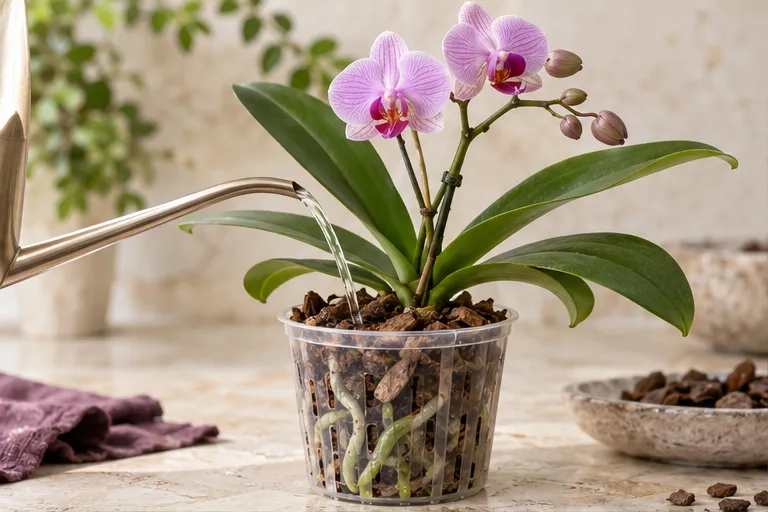
Feed growing roots
New root tips and expanding leaves indicate active growth. A flowering moth orchid may also be growing, while another plant may be resting. Seasonal calendars provide context, but indoor light and temperature can shift the cycle.
For many indoor growers, a low concentration applied periodically is easier to manage than a strong dose given infrequently. “Weakly, weekly” describes an approach, not a command to fertilize a wet pot every seven days.
| Plant condition | What to do |
|---|---|
|
Firm roots and active new growth
|
Use a measured, modest feed appropriate to the product and growing conditions.
|
|
Very dry medium
|
Rewet the roots with plain water before applying fertilizer.
|
|
Soft roots or a failing crown
|
Investigate the problem; do not increase fertilizer.
|
|
Recent major root loss
|
Prioritize recovery and avoid a strong feed on damaged tissue.
|
|
A confirmed seasonal rest
|
Follow the seasonal needs of that orchid group; a year-round feeding routine may not fit.
|
Rinse away excess salts
Water evaporates, but dissolved salts can remain in the mix. White crust on the pot or bark and damaged root tips are reasons to review fertilizer concentration and water quality. They do not identify the exact cause by themselves.
Periodically flush the pot thoroughly with plain water and let it drain. Do not send the runoff back through the same plant. If the mix has already broken down or become heavily encrusted, flushing may not be enough; repotting may be the better correction.
A short record is enough: date, product, amount, water volume and whether that watering used plain water. It prevents accidentally treating every watering as a feeding after a change in weather.
Check the water source
Hard tap water contributes minerals. Reverse-osmosis and distilled water contribute very few. A feed designed for one water source may not provide the same nutrient balance with another. Sodium-softened water adds a separate salt concern.
Do not assume that a layer of white residue proves you used too much fertilizer; the water can contribute deposits too. Check the source before adding supplements. Do not stack calcium, magnesium or other supplements on top of a complete formula without a specific reason.
Do bloom boosters help?
Extra fertilizer cannot substitute for adequate light, healthy roots or the temperature pattern a plant needs. A nutrient shortage can limit growth, but lack of flowers by itself is not evidence of phosphorus deficiency. Check light, roots and flowering conditions before adding another product; see how to get an orchid to rebloom.
A larger middle number on the label does not by itself cause flowering. What matters is whether the full feeding routine supports growth without leaving excess salts.
When to pause feeding
If root tips deteriorate after a change in feeding, return to careful plain-water management while you check concentration, water quality and drainage. Do not immediately add a second supplement to correct a suspected deficiency from leaf color alone.
Inspect the mix and the roots before blaming the fertilizer. Wet, oxygen-poor medium, very dry roots, temperature stress and pests can produce overlapping symptoms. For a declining plant, orchid problems is a better starting point than another bottle.
Keep the routine simple
Keep the product, measuring method and water source consistent while you learn the plant. Adjust one factor at a time, within the label's directions. Note active growth and schedule occasional plain-water flushing.
Look for new root tips and normally developing leaves. When roots and leaves are growing normally, keep the feeding dose steady even if flowering slows.
Common questions
Should I fertilize an orchid while it is blooming?
Blooming alone does not decide the answer. Consider active growth, root condition and the product directions. Do not increase fertilizer just to keep existing flowers open.
Can I use regular houseplant fertilizer?
Sometimes, when the product is suitable and correctly diluted. Check the label, micronutrients and rate instead of copying the volume used for another fertilizer.
Will fertilizer make an orchid rebloom immediately?
No. Light, root health, maturity and the temperature response of the orchid also matter. More concentrated fertilizer can cause damage without producing a flower spike.
More Orchid Care Guides
Orchid Care for Beginners
Just brought an orchid home? Check the pot, choose a window and settle into a simple watering routine.
Read the guide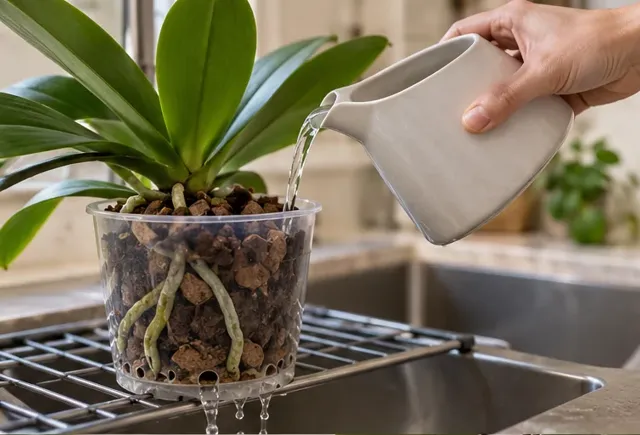
How to Water Orchids
Check moisture inside bark or moss, water thoroughly and let the pot drain. Learn what root color can—and cannot—tell you.
Read the guide