
Prepare
Have the new pot, medium and clean cutting tool ready.
Know when an orchid needs repotting, how to choose bark or sphagnum, how to size the pot and what to do with healthy and damaged roots.
The safest repot starts with a reason: old medium, a root problem, poor drainage or a plant that no longer fits. These guides cover the main decisions before and during the job, including what a clear pot can reveal about the root zone.
Move from removal and root inspection to fresh medium and a stable plant without unnecessary cutting.
Open guide →Understand what bark, sphagnum and common additives change in moisture retention and airflow.
Open guide →Choose by drying rate, pot design and your watering habits instead of treating one medium as universally better.
Open guide →Fit the container to the healthy root mass and make drainage and inspection easy.
Open guide →See roots and moisture through the pot, choose a size that fits the root system, and keep runoff out of decorative covers.
Open guide →The pot, medium and root mass work together. Coarse bark usually creates larger air spaces and faster drying. Sphagnum can hold much more water, especially when packed tightly. A larger pot also holds a larger volume of wet medium, which can keep a small root system damp longer.
Repot when the root environment needs improvement; visible aerial roots alone are not a problem. Many orchids naturally make aerial roots. Timing also depends on the orchid group; for many sympodial orchids, the beginning of new root growth is a useful repotting window.
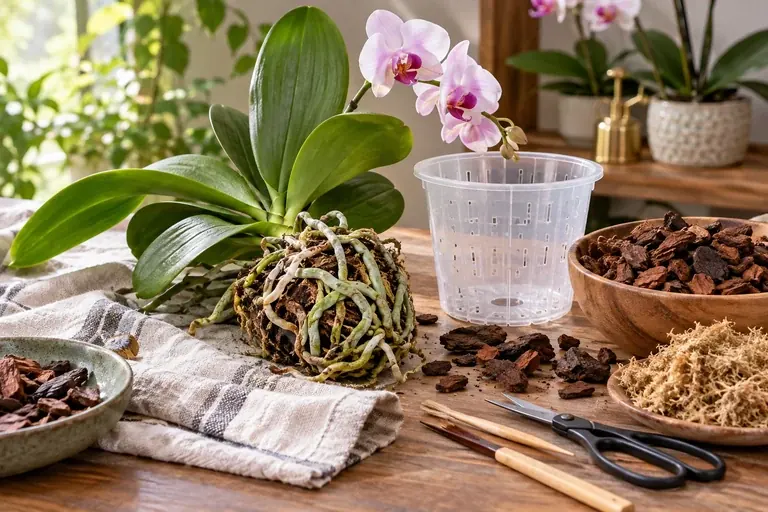
Bark generally drains quickly and leaves larger air spaces, but particle size and decomposition matter. Fine, old bark can hold more water than fresh coarse bark. Sphagnum can be useful where more moisture retention is needed, but a tightly packed mass can stay wet in the center long after the surface looks dry.
Match the medium to the orchid, pot and room. A grower who waters frequently may prefer a more open mix; a very dry indoor environment can justify more moisture-retentive material. There is no single mix that removes the need to check roots and drying rate.
When changing from moss to bark or the reverse, expect the pot to behave differently. Do not keep the old watering interval unchanged.
Most repotting mistakes happen because pot size, root condition and moisture behavior are treated as separate choices.
| Decision | What matters | Avoid |
|---|---|---|
| Repot now? | Broken-down medium, poor drainage, root trouble or lack of room for appropriate new growth are stronger reasons than aerial roots alone. | Repotting a healthy plant repeatedly without a need. |
| Which roots to remove? | Keep firm living roots; remove tissue that is clearly dead, hollow or mushy with a clean tool. | Cutting healthy roots to force the plant into a tiny pot. |
| How large a pot? | Choose enough room for the healthy roots and expected near-term growth. | A much larger pot filled with medium that stays wet around a small root mass. |
| Bark or moss? | Choose by orchid type, airflow, humidity and how quickly you can let the pot approach the right dryness. | Choosing by appearance alone. |
| After repotting | Keep the plant stable and watch how the new medium dries. | Returning immediately to the old watering schedule without checking the new pot. |
Set up the container and medium first so exposed roots spend less time being handled.
Have the new pot, medium and clean cutting tool ready.
Ease out the plant and separate old medium without tearing firm roots.
Keep living roots; remove only clearly dead or rotten tissue.
Set the plant at the correct level and avoid burying the crown.
Learn how the new pot dries before setting the next watering interval.
Visible roots and an untidy pot can look dramatic, but neither is a reason to disturb a healthy orchid by itself.
Many epiphytic orchids naturally produce roots outside the pot. Do not cut firm aerial roots merely to make the plant look neater. Repot when the medium, drainage, root health or available space for appropriate new growth gives you a real reason.
Extra medium around a small root system can remain wet much longer than expected. The new pot should accommodate healthy roots without creating a large reservoir of damp mix. Overpotting can turn a watering routine that worked before into a root problem.
Loose sphagnum and tightly packed sphagnum do not dry at the same rate. If you switch media, treat the first weeks as a new system: check the center of the pot and learn its drying pattern before repeating the old watering interval.
Keep firm living roots whenever practical. Removing healthy roots just to fit an ornamental container sets the plant back and reduces its ability to take up water. Choose the container around the viable root system, not the other way around.
A suitable pot and fresh medium should make moisture easier to manage while leaving the living roots intact.