
Check before watering
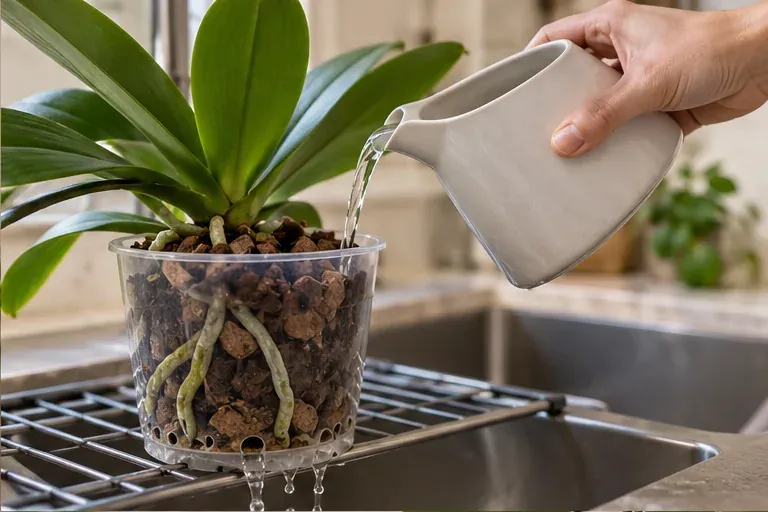
First, lift the growing pot out of its cover. If there is water in the bottom, empty it. Next, check accessible medium below the surface; the center dries more slowly than exposed bark. Finally, compare the pot's weight with how it felt after the last watering. You will learn that difference more reliably than a calendar interval.
A clean wooden skewer placed carefully between roots can help check the center. Avoid forcing it through roots, and keep it dedicated to one plant. Pull it out and feel for dampness. Compare what you feel with the weight of the pot; the skewer is a second check, not an exact measurement.
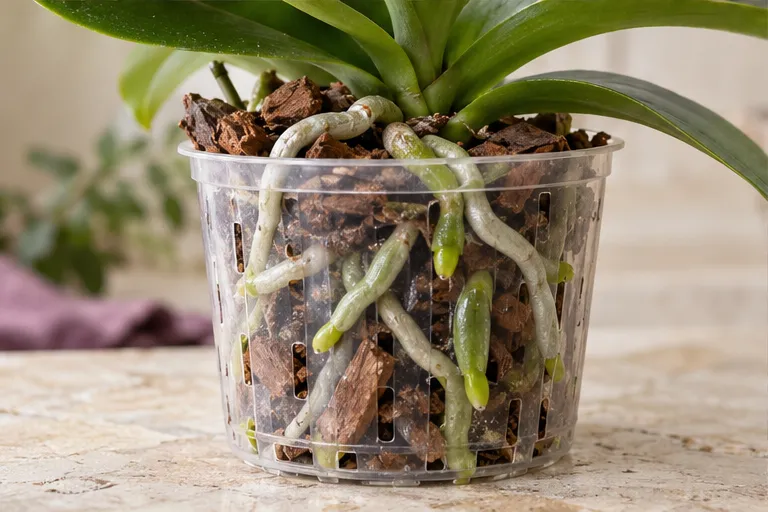
Look at root color too. Many exposed Phalaenopsis roots become greener when wet and silvery as their outer layer dries. Roots deep in a dark pot can be pale or yellowish and still be alive. Algae and staining can also obscure the picture. Check root firmness, moisture in the mix and pot weight together.
Water, then let it drain
- Remove the orchid from its decorative cover. Use room-temperature water, not hot or ice-cold water.
- Pour gently onto the potting mix and keep water out of the crown where the leaves meet.
- Let water run freely through the drainage holes. If very dry bark sheds the first pass, pause and repeat until it is evenly wetted.
- Allow runoff to finish. Check the leaf joints and blot away trapped water with a clean tissue.
- Return the growing pot to an empty cover or saucer. Check again that the pot is not sitting in runoff.
Watering early in the day gives accidentally wetted foliage more time to dry. Use fresh water for each plant; do not circulate a communal soaking bath through a collection when plant health is uncertain.
A short soak can wet reluctant bark, but it is not mandatory. Use a clean container, keep the crown above the water, and lift the pot out to drain. Leaving a bark-grown orchid submerged is not the same as watering it.
Bark or moss?
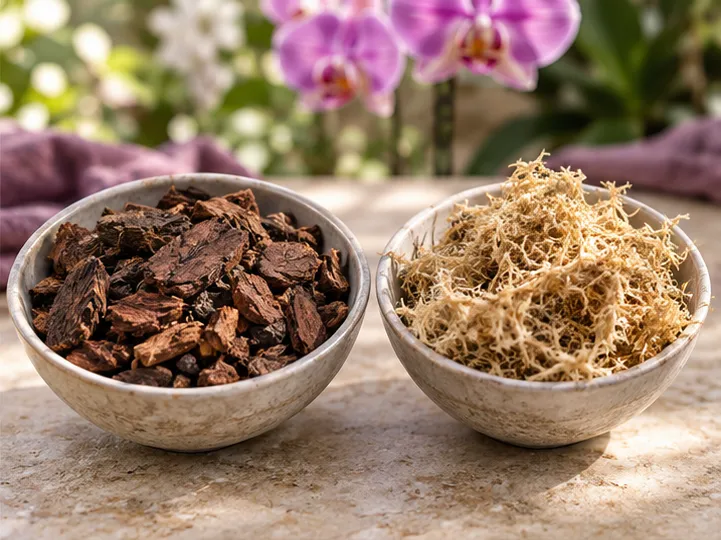
Moss can work well, and bark can still stay too wet. What matters is how the medium dries in your room.
Fresh bark can shed water at first. If water runs straight through a newly repotted bark mix, pause and wet it again rather than assuming the center is saturated.
Long-fiber sphagnum holds water much longer when it is packed tightly. Keep it springy rather than compressed, and check the center before watering again.
Changing from moss to bark, or from bark to moss, changes the drying pattern. Do not carry the old calendar interval over to the new medium.
| Medium | Common trap | Check instead |
|---|---|---|
|
Coarse bark
|
Dry top pieces while the center is damp; water running straight through very dry bark
|
Compare center moisture with pot weight; repeat a gentle watering pass if needed.
|
|
Long-fiber sphagnum
|
A crisp outer layer hiding a dense, wet center
|
Feel a small accessible area below the surface without packing it down.
|
|
Bark around a moss plug
|
Dry outer roots while the plug holds water
|
Check near the center, not just against the clear pot wall.
|
|
Old, broken-down mix
|
A surface that looks unchanged while fine particles fill air spaces
|
Inspect drainage and root condition; changing the interval alone may not fix the mix.
|
Why timing changes
A small pot in a warm, bright room can dry faster than a larger pot near a cool window. A running heater, summer warmth, active growth and additional ventilation can all change demand. Lower winter light can reduce it. These effects can overlap, so a single summer or winter schedule is still only a guess.
For the first few waterings, note how long the pot takes to dry. Write down the date, its condition before watering and whether the center had dried. The record is useful because it tells you when to check again, not because it gives you permission to water without checking.
What about ice cubes?
Ice can deliver a measured amount of water, but a set number of cubes cannot tell you whether the pot needs watering. Controlled trials with potted Phalaenopsis have not found the inevitable injury sometimes claimed; that does not make ice necessary or suitable for every setup.
Room-temperature water is the simpler choice for wetting the mix evenly and checking runoff. Water only when the medium needs it, then empty the cover pot. Do not put ice directly on leaves or exposed roots.
Water and fertilizer
Many orchids grow successfully with ordinary tap water. Salt-softened water and water with a high mineral load need more care; visible deposits and recurring root-tip damage are reasons to check water quality before changing the fertilizer dose. Rainwater, reverse-osmosis water and distilled water have different mineral contents, so the fertilizer routine must match the water you actually use.
Apply fertilizer according to the product label and the plant's growth, not at every watering by default. Periodically flushing the mix with plain water helps limit accumulated fertilizer salts. See orchid fertilizer for dilution and flushing.
Limp leaves in a wet pot
Limp leaves mean the plant is not maintaining its water supply. They do not prove that the pot is dry. If roots are soft, hollow or collapsing in wet medium, adding water will not make those roots healthy again. Inspect for root rot.
If the roots are firm and the pot is genuinely dry, restore a thorough water-and-drain routine. Old leaf wrinkles may not disappear completely; new roots and stable new growth are better signs of recovery. If leaves stay limp, compare the dry-pot and wet-root patterns in wrinkled orchid leaves.
Common questions
How often should I water an orchid?
Check when the mix approaches dryness. The interval depends on the plant, medium, pot and room. Use past watering dates to remind you to inspect, not as an automatic schedule.
Can I bottom-water a moth orchid?
A short soak in a clean container can wet the mix, provided the crown stays above water and the pot drains afterward. Do not leave the plant standing in the soaking water.
Are green roots a reason never to water?
No. Color alone cannot describe moisture throughout the pot. Consider the roots inside the pot, the mix and pot weight together; firm roots can also be stained or naturally pale.
More Orchid Care Guides
Orchid Care for Beginners
Just brought an orchid home? Check the pot, choose a window and settle into a simple watering routine.
Read the guide
Orchid Light Requirements
Find a suitable window, recognize sun and heat damage, and decide whether your orchid needs a grow light.
Read the guide