
Roots
Firm roots and a stable crown come before flowering stimulation.
Indoor orchid care for roots, new growth, flower spikes and after-bloom care. Build conditions that support steady growth and future flowering.
Roots and leaves show whether the plant has enough resources for another flowering cycle. Start with roots, post-bloom care, reblooming and new-spike identification.
Tell firm living roots from damaged tissue, and learn why an aerial root over the rim usually belongs there.
Open guide →Decide what to do with the flower spike while keeping light, watering and root care steady.
Open guide →Check plant strength and light first, then consider temperature cues for a common Phalaenopsis hybrid.
Open guide →Compare shape, position and surface features before staking or cutting an unfamiliar new growth.
Open guide →A plant that is producing firm roots and healthy leaves is building the structure needed to support flowering. Light is central because it powers that growth. Temperature can act as a flowering cue in some orchids, but it cannot compensate for a weak root system or a persistently dim position.
Many common moth-orchid hybrids respond to a period of moderately cooler conditions after healthy growth. Daytime warmth matters too; cool nights alone may not help a plant kept hot all day. Dendrobiums, Cattleyas and Oncidium-alliance plants have different seasonal patterns.
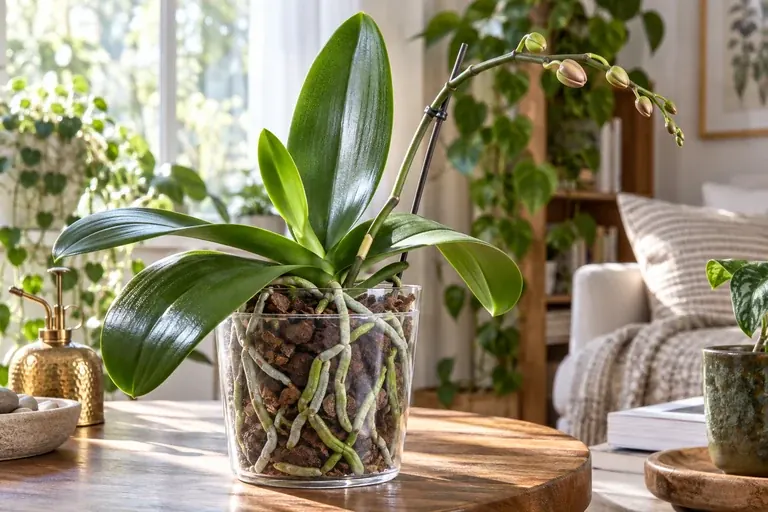
After flowering, keep caring for the whole plant. Do not treat the end of bloom as a dormant period unless the orchid type genuinely has one. A Phalaenopsis normally continues using light and water while it makes roots and leaves.
Watch the newest growth. Old leaves and spent spikes will not stay perfect forever; firm new roots, stable leaves and gradual growth tell you more about current health.
When a new tip appears, give it time before deciding whether it is a root or a spike. Very early growth can be ambiguous. Position and shape become clearer as it extends.
One observation is rarely enough. Combine the location of the change with root condition, moisture and recent environment.
| What you see | Likely context to check | Next step |
|---|---|---|
| New root tip | Active root growth; often a good sign that conditions are supporting the plant. | Keep the routine stable and avoid damaging the growing tip. |
| Green old flower spike | The spike is still living, but it may or may not branch or flower again. | Choose whether to leave or trim it based on plant strength and your goal. |
| Brown dry spike | The tissue is finished. | Trim the dry portion with a clean tool without cutting healthy leaves or roots. |
| No spike despite healthy leaves | Light may still be insufficient, or the plant may not yet be at the right stage. | Check actual light at the leaves before changing fertilizer or temperature. |
| Buds dropping | Rapid temperature changes, drafts, root stress or other disturbances can contribute. | Stabilize the growing conditions and inspect the roots before adding more fertilizer. |
A flowering attempt makes more sense when the plant is already functioning well.
Firm roots and a stable crown come before flowering stimulation.
Look for maintained leaves or healthy new growth.
Check the light where the leaves sit, including on short winter days.
Apply temperature cues only when they fit the orchid you have.
Avoid cold drafts and large simultaneous changes.
The most common reblooming mistakes start when a grower treats flowers as a separate project from roots, leaves and light.
A moderate temperature pattern can help initiate spikes in many common Phalaenopsis hybrids, but cold drafts and abrupt drops can stress the plant and developing buds. Measure near the leaves and stay within conditions appropriate for the orchid type.
A living old spike can remain green without producing another branch. Leaving it is one option, but the plant may not use it again. The plant may instead invest in roots and leaves, and that vegetative growth can be more important for the next strong flowering cycle.
A plant in a dim position may remain alive yet flower poorly. Before changing fertilizer formulas, check whether useful light actually reaches the leaves for enough of the day. Correcting light is often more fundamental than feeding harder.
A tiny root tip and a very young spike can be difficult to distinguish at first. Avoid staking, bending or cutting new growth immediately. Shape, position and surface features become easier to read after it extends a little farther.
Only after roots, leaves and light are in good shape is it worth adjusting temperature for flowering.