
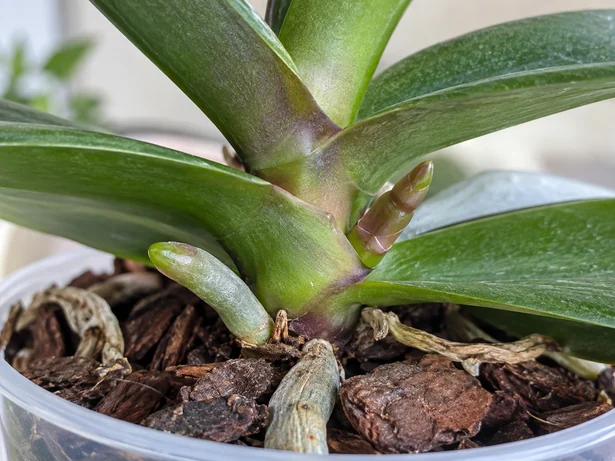
Look at the growing tip
These features work better together than alone. Pigmentation varies between hybrids, and a very young growth may not display enough structure for a confident identification.
New root
Rounded tip, smooth body. The active tip is often green or reddish. A paler, silvery covering develops behind it; the root has no flowering nodes.
New flower spike
Flatter tip, uneven outline. As the stem grows, small bracts mark its nodes. A tiny bump may be too young to show these features.
| Feature | New root | New flower spike |
|---|---|---|
|
Tip
|
Commonly rounded and smooth
|
Often flatter, with an uneven or mitten-like outline
|
|
Body as it extends
|
Cylindrical, with velamen developing behind the tip
|
A stem that later shows nodes or small bracts
|
|
Typical color pattern
|
Green or reddish active tip, with a paler outer covering behind it
|
Often green or reddish-green, without the same silvery velamen
|
|
Direction
|
Can grow outward, downward or upward
|
Often grows outward and then toward light, but not invariably
|
|
Safe early handling
|
Leave it unbent and protect the tip
|
Leave it unbent until it has enough length for gentle support
|
Too small to identify?
At the earliest stage, both structures can look like a pointed green bump. If the shape is still unclear, wait; a little more growth usually reveals more than handling it.
Take a clear photograph from the side and another from above, without prying leaves apart. Compare again after it has lengthened. You are looking for the development of a round root body or a nodal flower stem, not for a change within a fixed number of days.
Do not scrape a tip, press it between your fingers or bend it to see whether it feels like a root. Those tests can damage the very growth you are trying to identify.
Look for nodes
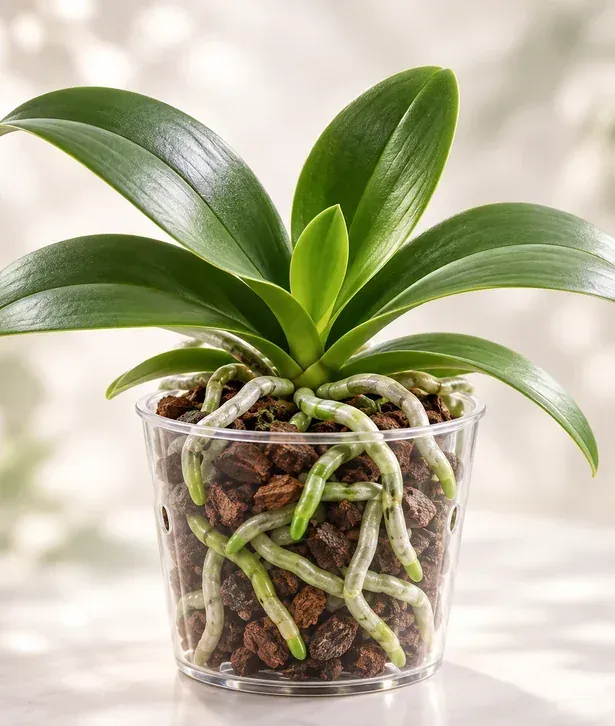
A flower spike develops nodes along its length. A small bract or raised segment can become more obvious as it grows. Roots do not produce the same sequence of flowering nodes; instead, they can branch into additional roots.
A spike can emerge between leaves, but origin alone is not decisive. Roots also emerge from the short central stem and can grow through unexpected gaps. Nor is “it is pointing up” a reliable rule: an aerial root can do that as well.
If you are unsure, leave it alone and keep normal care. Both a young root and a flower spike are easily damaged. For normal root colors, texture and active tips, see healthy orchid roots.
When to add a stake
Wait until the spike has enough length and strength to work with gently. Position a support carefully without driving it through visible roots. Use a loose orchid clip or a soft tie that supports the stem without pinching it.
Do not try to straighten a firm curved stem in one movement. A naturally arching spike does not have to be forced into the shape of a store display. If resistance is obvious, keep the natural curve; forcing it can snap the spike.
Keep the plant reasonably stable in relation to its light source while the spike develops. Constantly turning it to produce a particular shape makes observation more difficult and can lead to unnecessary handling.
When it is a root
A new root helps the plant take up water and support later growth. Keep it clear of sharp pot edges and avoid removing it because it will not fit inside the cover pot.
Do not repot solely because one root has crossed the rim. First consider whether the current medium is still fresh and draining well and whether the pot genuinely no longer fits the healthy root system.
A root with a bright tip may dry at the surface faster than roots inside the pot. Do not use that exposed tip as the only signal to water. Check the mix, as described in watering orchids.
Leaf, spike or baby plant?
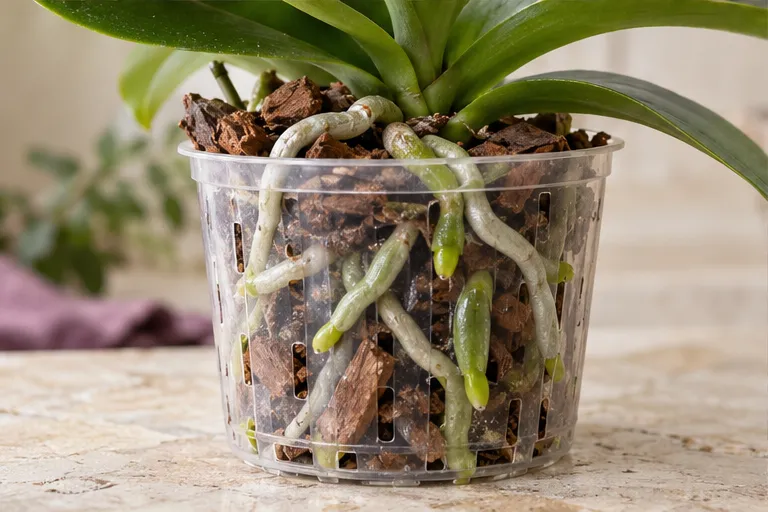
A leaf emerges from the central growing point of the main plant. It does not extend as a round root or a nodal flower spike. A keiki is a small plantlet that can develop leaves and, later, its own roots, sometimes on a flower spike.
Do not cut off an uncertain growth as an “extra stem.” Leave developing plantlets attached while identifying them and learning their needs. A tiny leafy growth may not yet have enough roots to be removed and potted separately.
If the center of the main plant is soft or damaged, do not assume every new growth proves it has recovered. Check the crown and roots as well.
A dry or stopped spike tip
A paused tip does not tell you its cause. Review recent changes in light, water, temperature and handling. Do not repeatedly add fertilizer to force extension.
A fully dried tip will not extend again from dead tissue, although a healthy remaining spike may sometimes branch. If buds shrivel or drop, check for bud and flower stress; bud loss is a separate stress problem, not evidence that the spike was misidentified.
Compare without handling
Take one side view that shows the tip and another that includes the nearby leaves. Repeat from the same angle once the growth extends. Look for a smooth root body or distinct spike nodes; a blurred close-up may hide both.
Leave an uncertain growth uncut and unbent. You do not need an immediate identification to continue normal watering and filtered light.
Common questions
Can orchid roots grow upward?
Yes. Aerial roots can grow upward or sideways, so direction alone cannot distinguish a root from a flower spike.
Is a purple tip always a flower spike?
No. Pigmentation varies, and active root tips can also be reddish or purple. Compare shape, the developing body and the presence of nodes.
Should I move the plant when I find a spike?
Avoid unnecessary moves. Keep appropriate light and stable conditions; a developing spike is not a reason to expose the plant suddenly to stronger sun or colder air.
More Orchid Care Guides
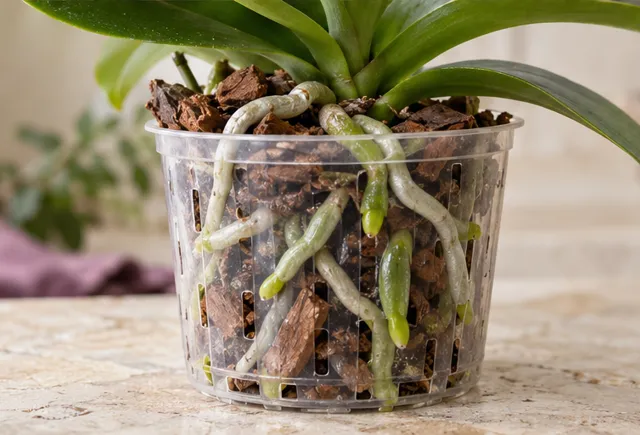
Healthy Orchid Roots
Tell normal silver or pale roots from damaged ones, understand aerial roots and know when to inspect inside the pot.
Read the guide
Orchid Care After Blooming
Decide what to do with a green or brown flower spike, when to repot and how to care for the plant between blooms.
Read the guide