
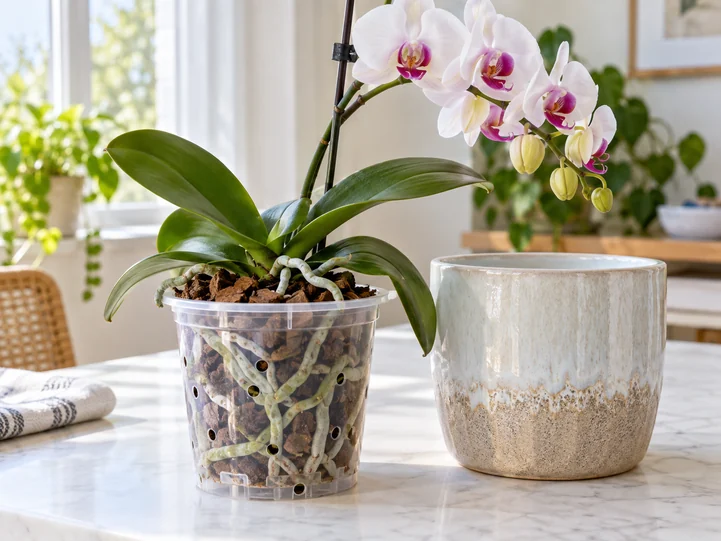
Start with drainage
A growing pot needs openings that let excess water escape. Side slots can improve access to air, but they do not excuse blocked bottom holes or a pot standing in runoff. If the mix remains saturated, examine pot size, medium and drainage together; adding holes alone may not solve it.
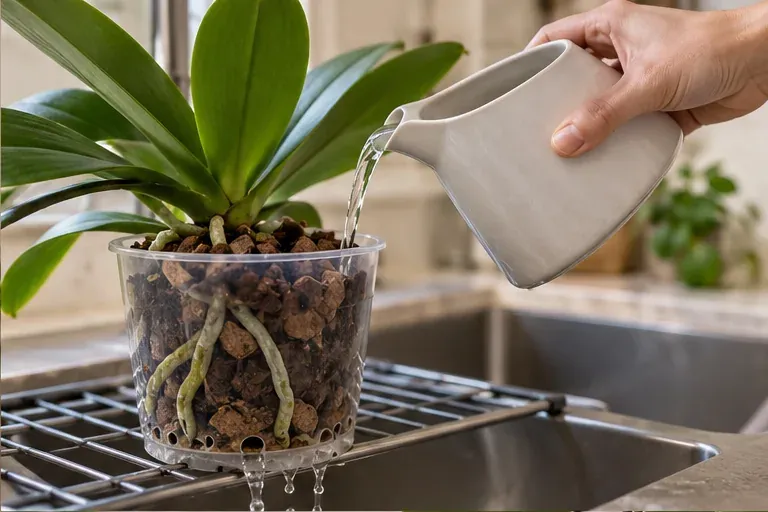
Some attractive orchid displays use a draining inner pot inside a closed ceramic cover. That is workable when you remove the growing pot to water, let it drain and empty the cover before returning it.
Do not assume that a layer of pebbles inside a closed container creates the equivalent of drainage. Water that cannot leave the container still needs to be managed.
Compare pot materials
The right choice depends on the mix and the room. A very open pot is not universally better if it dries faster than you can reasonably water.
| Pot type | Main benefit | Trade-off |
|---|---|---|
|
Clear plastic
|
Makes root condition and moisture easier to inspect
|
Can stay wetter than a porous pot; algae may develop on lit surfaces.
|
|
Opaque plastic
|
Light, durable and moisture-retentive
|
You rely more on pot weight and medium checks.
|
|
Terracotta
|
Porous walls can help a pot dry; extra weight improves stability
|
Roots can adhere to it and dry faster near the walls.
|
|
Slotted or net pot
|
Open structure and easy drainage
|
Can dry very quickly in a dry room; fine medium may escape.
|
|
Glazed ceramic with drainage
|
Stable and decorative
|
Inspect the actual holes and internal shape; appearance says little about drainage.
|
|
Closed decorative cover
|
Hides the growing pot without changing it
|
Must not hold runoff around the roots.
|
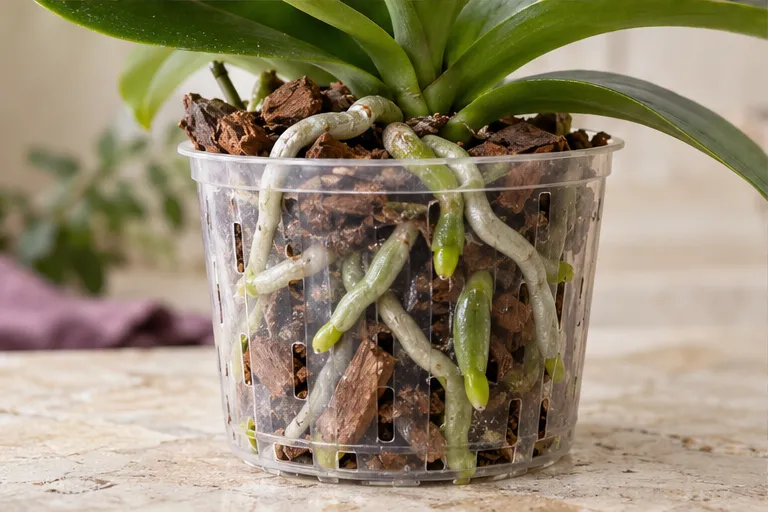
Size it for the roots
When repotting, judge the size after removing old medium and identifying healthy roots. The roots should fit without hard bends, with room to place fresh medium between them. Avoid a large empty volume around a small root system.
A common mature moth orchid may stay in the same pot size through several changes of medium. If substantial roots have been lost, it may need a smaller pot. Leaves and flowers do not change that calculation.
Measure the inside width and depth, not the decorative rim. A pot marked 4 inches (10 cm) may have a narrower base. Try the cleaned roots in the empty pot before adding mix; moving up by 2 inches (5 cm) can add far more wet medium than a small root system needs.
Check the fit before filling
- Too tight: roots need sharp bends or pressure to fit. Try the next size or a different shape.
- Fits: roots settle naturally, the leaf bases stay above the rim and fresh mix can slip between the roots.
- Too large: a small root bundle leaves a wide ring of empty space. Use a smaller growing pot and a heavier outer cover for stability.
For example, compare a 4-inch (10 cm) pot and a 5-inch (13 cm) pot with the same cleaned root system. Choose the smaller one if the roots fit without forcing; choose the larger only when the roots need that space.
Does the pot need to be clear?
No. Many orchids grow well in opaque pots. Clear plastic is helpful while you learn the plant because you can see part of the roots and mix without repeatedly disturbing it. That visibility is an advantage, not a requirement that all roots receive direct light.
The roots visible at the walls do not show the entire center. Check moisture below the surface and compare weight even with a clear pot. A transparent pot can still hide a compact wet plug behind healthy-looking outer roots.
Algae on a clear pot is not itself proof that the orchid is dying. Consider how long the mix stays wet and whether the roots remain firm before deciding what needs changing.
Support a top-heavy plant
Keep the crown and leaf bases above the mix. Burying a moth orchid deeper to stabilize it can hold moisture against vulnerable tissue. Support a loose plant gently instead.
A heavier decorative cover can steady a light inner pot. Leave the drainage system accessible and avoid wedging the growing pot so tightly into its cover that removal becomes difficult.
A long spike can also be supported separately. Do not use pot size as the only way to balance the weight of flowers.
Adding drainage holes
A purpose-made draining pot is often easier and safer than modifying a brittle container. Any added opening must have smooth edges that will not scrape roots, and the material must remain firm and intact.
A few new holes will not correct decomposed medium or a dense central plug. If drainage slowed as the mix aged, replace deteriorated medium before drilling more holes.
Do not drill or cut around a plant that is still in the pot. Remove it safely first, or choose a different pot during the next necessary repot.
Reusing an old pot
Remove old bark, moss, deposits and visible debris. Wash the pot, then use an appropriate disinfecting method according to the product directions if disease or shared use is a concern. Rinse when directed and allow the pot to dry before reuse.
Cracked pots, sharp slots and a shape that traps roots may not be worth saving. If healthy roots have firmly attached to a pot, avoid tearing them just to save an inexpensive container.
Check after the change
A different pot can change drying even when the mix stays the same. Terracotta, extra slots or a shallower shape may increase water loss. A larger or less porous pot may slow it.
For the next several cycles, check instead of copying the old watering interval. Aim for a pot that supports the plant, drains freely and can be watered predictably. See how to repot an orchid for fitting the roots and watering orchids for checking the new setup.
Common questions
Do orchids like to be root-bound?
They often do well in a snug, appropriately sized pot, but that does not mean severely compressed or damaged roots are desirable. Fit the container to the healthy roots and medium.
Can an orchid live in a glass vase?
A closed vase without drainage is not a straightforward substitute for a draining orchid pot. Use it as an outer cover only when the inner pot can be removed and runoff emptied.
Do side holes prevent root rot?
Not by themselves. Medium condition, pot size, watering and standing water still matter. A slotted pot can remain too wet if the rest of the system is poorly managed.
More Orchid Care Guides
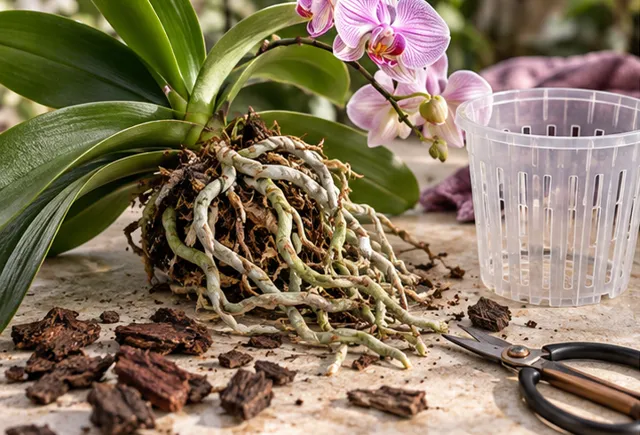
How to Repot an Orchid
Work through pot removal, root checks, fresh mix and aftercare without cutting healthy roots or burying the crown.
Read the guide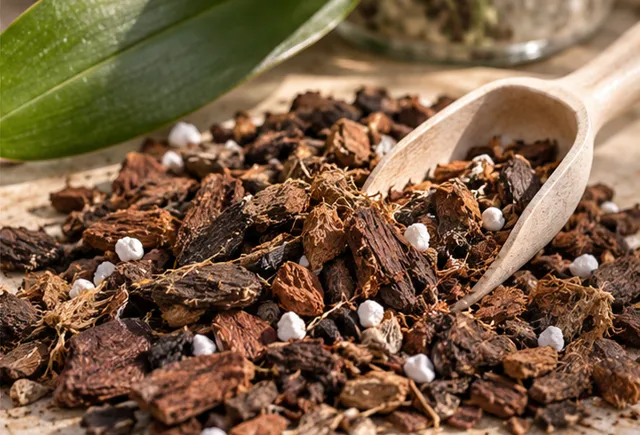
Choosing an Orchid Potting Mix
Compare bark, sphagnum and other ingredients, choose a particle size and spot a mix that needs replacing.
Read the guide