
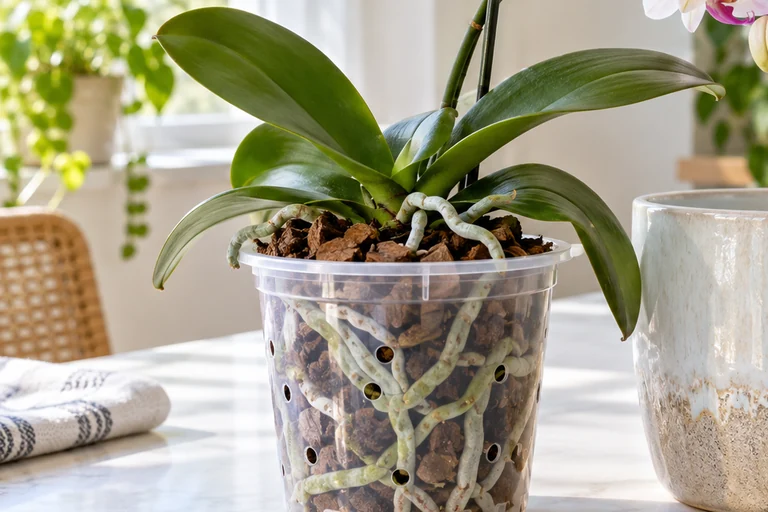
Firm roots, different colors
The outer root covering, called velamen, absorbs water and changes appearance as it wets and dries. Many Phalaenopsis roots turn green when wet and silver-gray when dry. A root inside a dark pot can be pale or yellowish because it has not received the same light.
Inspect gently. Do not pinch fresh root tips to test them, and do not repeatedly squeeze healthy roots. When an exposed older root needs closer inspection, a firm root generally holds its shape; a badly damaged one may flatten, feel hollow or shed its outer covering.
Different causes can damage roots in similar ways. Texture helps you decide which roots to keep, but does not identify a disease.
| What you see | What it can mean | What to do |
|---|---|---|
|
Firm silver-gray root
|
Dry outer velamen
|
Check the potting mix before watering.
|
|
Firm green root
|
Wetted outer covering or a light-exposed root
|
Consider the moisture inside the pot, not the color alone.
|
|
Firm cream or yellowish root inside the pot
|
A root grown with little light
|
Keep it unless there is evidence of physical decay.
|
|
Brown staining but a firm root
|
Staining, age or surface changes
|
Check texture and new growth before cutting a root because of its color.
|
|
Soft, hollow or collapsing root
|
Lost or damaged tissue
|
Assess the full root system and the mix.
|
|
Bright growing tip
|
Active root growth
|
Handle carefully; avoid disturbing or scraping it.
|
Leave aerial roots alone
Roots outside the pot are not failed flower spikes. They are roots growing into the surrounding air, and their presence alone does not prove the pot is too small. Do not trim them just because they do not fit the display.
Aerial roots dry faster than roots inside moss or bark. Watering every time an exposed root turns silver can keep the center of the pot too wet. Check moisture inside the pot before watering, using the steps in how to water orchids.
During repotting, a flexible aerial root may be positioned into the new pot if it fits without force. A stiff root that points outward can stay outside. Breaking it to make the plant look neat is not an improvement.
What a clear pot shows
A transparent pot helps you see roots without repeatedly unpotting the plant. It can also show algae, broken-down mix and roots against the sides. You may still be unable to see the center of the pot. Roots near the pot wall may be healthy even when roots in the center are damaged.
Look for a pattern: are roots becoming less firm, is the pot staying wet longer, and are leaves losing their normal firmness? Several changes together justify more attention than one discolored root.
With an opaque pot, compare its weight and check moisture below the surface. Leave a stable orchid potted unless its condition gives you a reason to inspect the roots more closely.
Root or flower spike?
A young root commonly has a rounded growing tip and a smooth, cylindrical shape behind it. A developing Phalaenopsis spike is often flatter at the tip and later shows nodes. The direction of growth is less reliable: roots can grow upward and spikes do not always point straight up.
A tiny bump may not have enough features to identify. Photograph it and leave it alone. As it lengthens, compare the tip shape and developing nodes with orchid spike vs. root.
When roots stop extending
A root tip that pauses is not necessarily dead. Growth can slow with a change in light, temperature or the plant's cycle. Check again over several weeks; daily measurement is not useful.
Check for a recent change: new medium, a different window, a stronger fertilizer solution or a colder room. If the plant is otherwise stable, correct a clear problem without repeatedly disturbing the root system.
New root tips are a good sign after repotting. After major root loss they may take time to appear, so judge recovery from the whole plant instead of a fixed deadline.
When to inspect the pot
An occasional old root at the surface is not the same as widespread root loss. Consider unpotting when several roots are soft, the mix has collapsed into fine wet particles, drainage is poor, or a plant becomes limp despite a persistently wet pot.
Prepare a clean work area and fresh medium before removing the plant. Separate old material gently and preserve every healthy root you reasonably can. For removal and potting steps, see how to repot an orchid; for widespread soft or collapsing roots, see orchid root rot.
Avoid turning inspection into major pruning. Do not cut a firm root just because it is brown, short or awkwardly positioned.
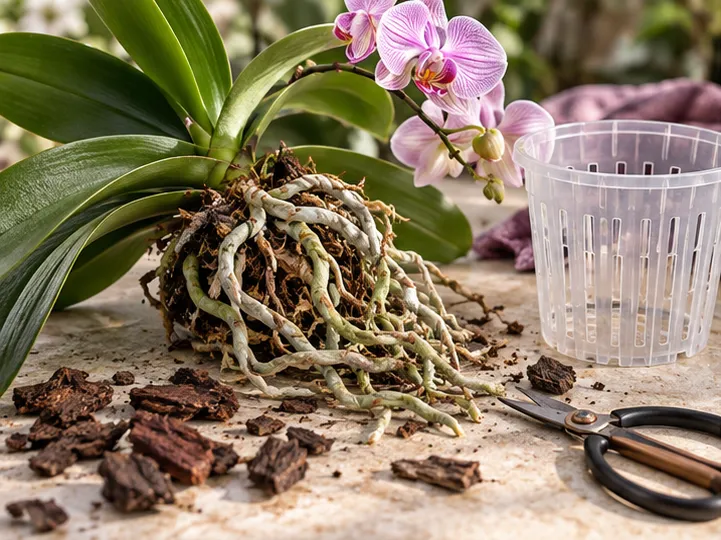
Signs of new root growth
A recovering orchid may stop declining before it starts to look better. Old leaves can remain creased, old damaged sections do not turn into new root tissue, and flowers may be sacrificed during stress. Watch for healthy new root tips, a stable crown and new growth that maintains its firmness.
Compare photographs taken under similar light. A change from silver to green after watering is normal hydration, not proof that damaged tissue has healed. New structure is the more meaningful sign.
Keep firm roots even when their color varies. What matters is that the mix takes up water, drains freely and does not stay wet for too long.
Common questions
Should I cut roots growing out of the pot?
No, not when they are healthy. Aerial roots are normal. Keep them intact and avoid forcing stiff roots into a pot during repotting.
Are yellow roots dead?
Not necessarily. Roots grown inside a dark pot can be pale or yellowish. Firmness and structural condition are more useful than color alone.
Do all orchid roots turn green after watering?
No. Appearance differs with the orchid, light exposure and staining. Check the orchid type, how firm its roots are and whether the mix is damp.
More Orchid Care Guides
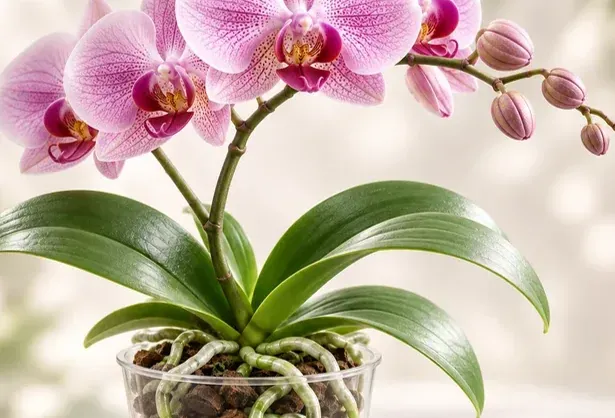
Orchid Care After Blooming
Decide what to do with a green or brown flower spike, when to repot and how to care for the plant between blooms.
Read the guide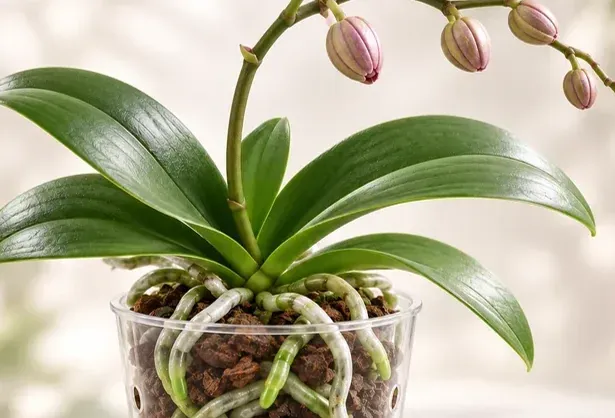
How to Get an Orchid to Rebloom
Check roots, light and temperature before trying to encourage a new flower spike. Know what to change—and what to leave alone.
Read the guide