
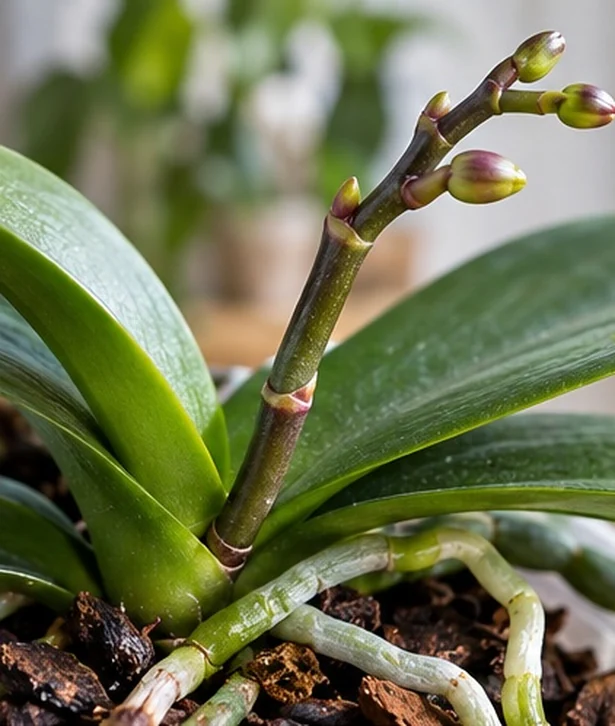
Is the plant ready?
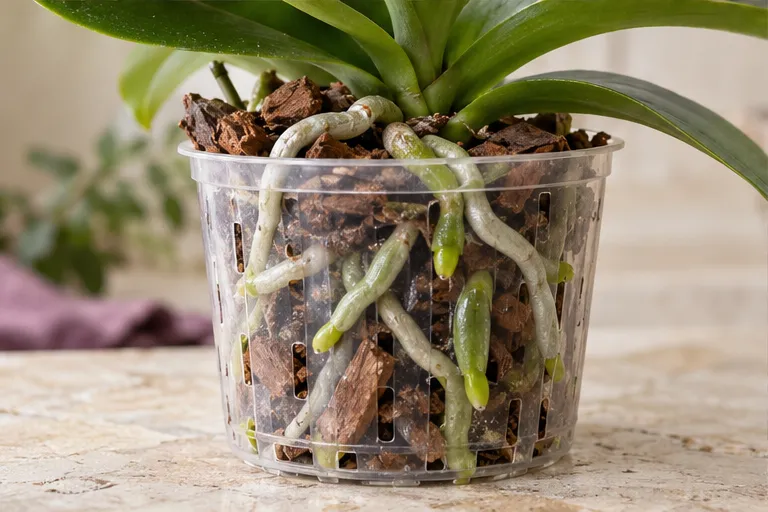
Look for a firm crown, healthy roots and leaves that hold their normal shape. A recently rescued plant with major root loss is not a good candidate for deliberate flowering stimulation. Recovery takes priority even if the old flower spike is still green.
A newly purchased orchid also arrives with an unknown recent history. It may have spent months producing its current flowers. Give it stable care instead of immediately trying to trigger the next flowering.
Before changing temperature
Start with the light
Inadequate light is a common reason orchids fail to flower. Move beyond the description “bright room” and check the actual leaf position. An orchid on a table across the room may receive much less suitable light than one near an unobstructed window.
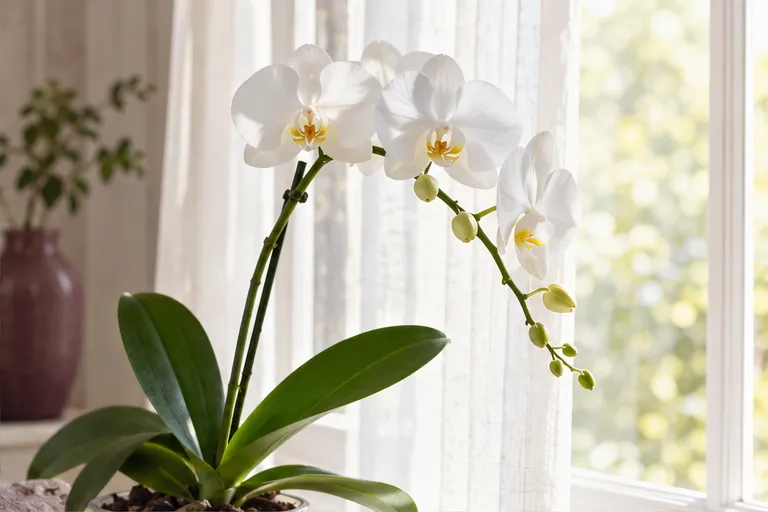
For a moth orchid, start with bright, filtered window light and avoid sudden strong sun. Compare the position at different times of day. A sheer curtain can reduce intense exposure without sending the plant to a dark corner. A grow light can help when the available window is persistently dim.
Do not make a large light increase and a large temperature change at the same time. Adjust gradually so the leaves stay stable and the result is easier to read. For window placement and grow-light checks, see orchid light requirements.
A cooler period
Many common Phalaenopsis hybrids start flower spikes after several weeks of moderately cooler conditions. Daytime temperature matters: greenhouse research on two hybrids found that hot days could prevent spiking even when nights were cooler.
For a healthy common hybrid, a practical starting range is 68–73°F (20–23°C) by day, with nights around 60–65°F (16–18°C). Keep filtered light, check moisture and watch for a new spike over the following weeks. These are growing ranges, not a reason to chill the plant abruptly.
Warmer-growing species and some novelty hybrids need different treatment. Do not put an unidentified orchid outdoors in cold weather or press leaves against cold glass. Once buds form, protect them from sudden changes in temperature and location.
Measure near the leaves
Use a min–max thermometer beside the leaves, shaded from direct sun. Read it at the same time each day and note both the daytime high and overnight low. The room thermostat can miss a hot sill or a cold draft.
Keep leaves away from the glass. If the daytime reading remains high despite cool nights, use a brighter, moderately cool room rather than exposing the orchid to progressively colder nights.
Let weak roots recover
Damaged roots cannot take up water and nutrients normally. If roots are soft and the mix stays wet, help the plant recover before trying to encourage flowers. Address root rot before changing the climate around the plant.
For a healthy plant, continue watering as the mix approaches dryness. Do not introduce a drought to “stress it into bloom.” Keep the crown dry after watering and let the pot drain completely.
Feed lightly when the plant is actively growing, using the label's directions. Increasing fertilizer strength is not a substitute for missing light or a weak root system.
Recognize the new spike
A developing Phalaenopsis spike often has a flatter, mitten-like tip and becomes visibly nodal as it lengthens. A new root is commonly rounder and cylindrical. At a very early stage, leave an uncertain growth alone.
Do not bend a tiny spike upright to test it. Once it is long enough, support it loosely without squeezing or kinking the stem. If the new growth is still ambiguous, compare it with orchid spike vs. root and leave the tip untouched.
From spike to flowers
Expect months, not days, between flower displays. Many common moth-orchid hybrids follow a seasonal flowering cycle, but the interval varies with the hybrid and growing conditions. A side branch from a living old spike follows a different timetable.
Once buds develop, keep the light and water routine steady. A new spike still needs time to elongate; stronger fertilizer will not make unopened buds ready overnight.
| What is developing | Timing to expect | What to watch |
|---|---|---|
A new main spike | Often seasonal; after a spike appears, flower development still takes substantial time and varies with temperature, light and the hybrid. | Tip extension, then distinct buds. Keep the plant in steady light. |
A branch on a healthy green spike | Timing varies. A suitable Phalaenopsis may branch after trimming, but some green spikes remain inactive or eventually dry. | A node swelling and producing a branch; do not keep recutting it. |
Roots after major root loss | Allow recovery to set the pace; a flowering timetable is not useful while roots are failing. | Firm new root tips and stable leaves before another bloom attempt. |
Still no new spike?
Review your record: has the plant produced a healthy new leaf, are roots extending, and did the light actually improve? A thriving plant that has not spiked yet may need more time or a different seasonal pattern. A plant that is not growing needs its basic conditions reviewed.
Do not repeat cooling cycles indefinitely while ignoring declining roots. Do not judge a care change after only a few days. Photograph growth every few weeks and compare the whole plant, not only the space where you hope a spike will appear.
For an orchid that has just finished its display, begin with after-bloom care. Keep healthy roots and new growth as the priority between displays.
Common questions
How long does reblooming take?
Many common Phalaenopsis hybrids flower seasonally, but the interval varies. A new main spike and a branch from an existing green spike do not follow the same timetable, and plants recovering from root damage may take substantially longer.
Should I put my orchid in the dark to make it flower?
No. Common moth orchids need suitable light to support growth and flowering. Darkness is not a substitute for an appropriate temperature response.
Can every Phalaenopsis be cooled the same way?
No. Common hybrids and warm-growing species or novelty hybrids can respond differently. Identify the plant and avoid applying a cooler treatment to a weak or temperature-sensitive orchid.
More Orchid Care Guides
Healthy Orchid Roots
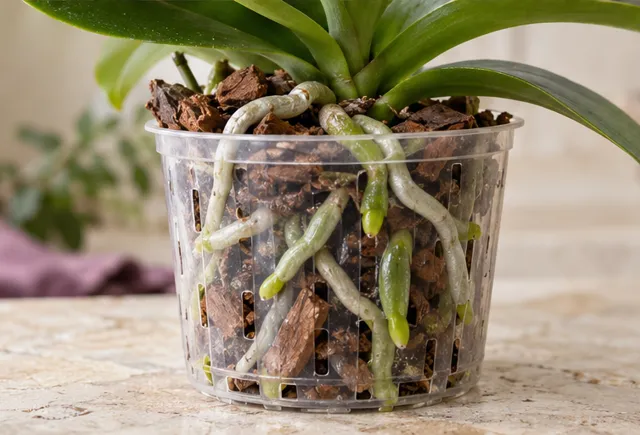
Tell normal silver or pale roots from damaged ones, understand aerial roots and know when to inspect inside the pot.
Read the guide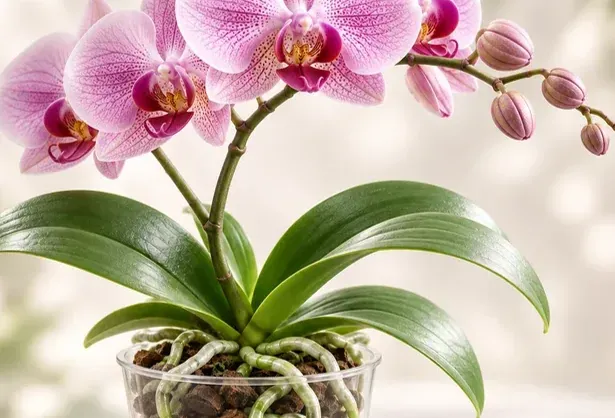
Orchid Care After Blooming
Decide what to do with a green or brown flower spike, when to repot and how to care for the plant between blooms.
Read the guide